
LEADINGThought LEADER SERIES: In Conversation with Jenny Garrett, OBE
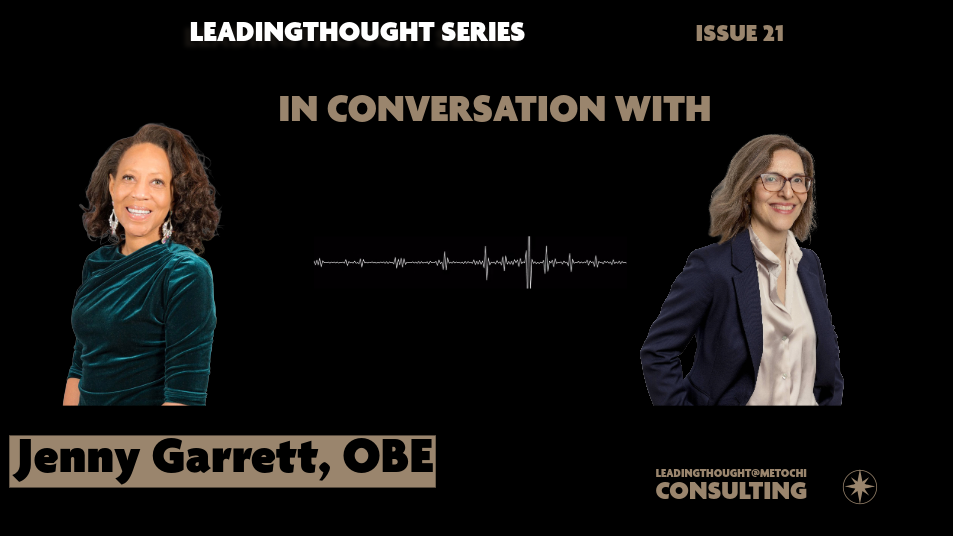
A conversation with
Jenny Garrett OBE
Founder & CEO, Jenny Garrett Global • Speaker & Author • Co-host, AI for Equity Podcast
For the 21st issue of LEADINGThought, we were delighted to welcome Jenny Garrett OBE — one of the UK’s leading voices on inclusive leadership — as she marked an extraordinary milestone: twenty years in business. Our conversation explored what it takes to build a values-led business that lasts, why she turned her attention to artificial intelligence, and how leaders can adopt AI without losing sight of the people at the heart of their organisations.
What followed was a wide-ranging and hopeful conversation — spanning Jenny’s two decades of impact, the pivot that led to her new book, AI for Equity, the three pillars now shaping her leadership approach, and the small, human practices that help make sure no one is left behind.
TWENTY YEARS IN BUSINESS
HOST
Jenny, welcome — and thank you so much for joining me. I have to start with an extraordinary milestone: you’ve just reached twenty years in business. When you look back on those twenty years — and I suspect you don’t do it very often — what are the moments that stand out, and what are you most proud of?
JENNY GARRETT
The standout moments are always about individuals. It’s wonderful to achieve awards and accolades, but the moments that really matter are when you’re with a client or a group of leaders and you can almost see that light-bulb moment appear — someone sees something very differently. It might be a person who’s never thought about their own brand and how they come across, or a leader who suddenly knows how to unlock the potential in someone else.
What’s been lovely over the years is that people stay in touch and let me know about each step of their journey — and I’m there cheering them on from the sidelines. I’ve watched people go from hitting a glass ceiling and feeling there was nowhere to go, to reaching very senior roles and changing the face of their organisations.
With one organisation, there were very few leaders from different backgrounds. Within about five years there was so much more diversity — and I don’t just mean in characteristics, I mean diversity of thought and the ability to be creative. Those are the moments that stand out: when you realise this isn’t how we started, and this person is standing taller and speaking up so much more than they did at the beginning.
BUILDING SOMETHING THAT LASTS
HOST
Many of the people reading this will be entrepreneurs and business owners themselves. How do you build a business that’s not only sustainable but genuinely successful over twenty years? Are there particular principles or moments that really moved things forward?
JENNY GARRETT
I might not give a unique answer, but the first thing is knowing your values and sticking to them. When you’re running a business there’s a lot of advice to fundamentally change who you are, and I just don’t think you can be successful if you do that.
The second is not competing with others. From the beginning I decided I’d compete with myself: am I better than I was a month ago, a year ago, five years ago? You can get very caught up watching other people jump on the next bandwagon. It should be about your own goals and where you want to go.
And then persistence and consistency. Sometimes the phone wasn’t ringing and nothing was happening — and the answer was to keep showing up, whether that meant getting to my desk each day or going to a networking event. You think no one’s looking, but they are. People are watching to see whether you’ll still be there in a year’s time, and whether they should invest their time and energy in getting to know you.
WHY AI, WHY NOW
HOST
You spent two decades building an award-winning consultancy rooted in inclusion. More recently you completed MIT’s AI strategy programme and wrote a book, AI for Equity. What pulled someone with such deep expertise in one area toward something so seemingly different?
JENNY GARRETT
I’m curious — that’s number one. I’m always curious when something is new or changing, and I’m always interested in the alternative view.
I was hearing a lot about AI, and none of it was good. I was listening to podcasts and reading books, and so much of it said this would be the end of humanity, that it would take all our jobs, that we’d all end up with brain rot. I thought: this might happen — but is there an alternative? Is anyone using AI in a way that helps? And could I be part of the solution, so the worst things don’t happen?
So, I asked my daughter to do some research into whether anyone was doing anything intentionally positive with AI at its intersection with diversity, equity and inclusion. Could people use AI to accelerate solutions to problems we’ve wanted to solve forever? She surfaced all these people doing amazing things, and I thought: we could amplify this and let more people know — let’s do that through a podcast.
I do want to say I don’t think AI is the panacea for all ills, and I’m not an evangelist. I know it has real potential to cause harm — from damaging the environment to a class of people paid very little to look through awful images for hours on end. There’s an undercurrent to all of this. But for me it’s about how we intentionally direct AI to solve the problems the world has.
WHERE AI BELONGS, AND WHERE IT DOESN’T
HOST
You’ve built a deliberately human model — seasoned partners, real relationships with your clients. As a CEO, how do you decide where AI belongs? And are there areas you’ve deliberately steered clear of, to protect what’s core to what you do?
JENNY GARRETT
One of the things we’ve tried hard to do is practise what we preach. When we engage with AI, we have to think about how we engage — we don’t want to be the kind of organisation that says “do as I say, not as I do,” even though we’re smaller than many of the organisations we work with.
So we asked: what’s our intention with AI? As a small organisation, it can help us punch above our weight — usually by streamlining and automating our processes so we have more time to be with clients, to bring our creativity and knowledge to the fore, to be out meeting people. We decided very early on that this is about augmenting the work we do. It’s never going to be about replacing people, because people are at the heart of our business, and we want organisations to value the people they have. We have to demonstrate that ourselves.
It comes back to knowing your values and thinking about how AI can align with them, so you can keep doing your very best work. Organisations do need to evolve — we’ve evolved a great deal, from leadership coaching to leadership programmes, to inclusion within leadership. Leaders have evolved, and we’ve evolved with them.
THREE LEADERSHIP PILLARS
HOST
Inclusive leadership is one pillar of your work, and you’re known as one of the UK’s leading voices on it. You’ve recently added two more — entrepreneurial and AI-ready leadership. How do those three pillars come together?
JENNY GARRETT
The core message is that AI adoption happens at the speed of trust, not the speed of implementation. People think they can put AI out there and everything will change. But if your staff don’t trust you, or don’t trust AI, nothing will happen.
Organisations tend to focus on the technology. The ones that succeed focus on people. AI isn’t primarily a technology transformation — it’s a human transformation enabled by technology.
So, the question becomes: what kind of human transformation do you need to be an AI-ready leader? What we found was that it takes the qualities of entrepreneurial leadership. We looked at what entrepreneurs develop and asked how we bring those qualities into larger organisations, or nurture them in smaller ones — because often it sits with a single leader, and the question is how you nurture it in others.
There are three areas to that: efficacy — can I make a difference here? Identity — can I show up as myself? And belonging — is this environment safe for me to be myself? Putting those conditions in place is what enables people to be AI-ready leaders. So inclusion is the foundation, AI-ready is where you’re going, and entrepreneurial leadership is the way to get there.
LEADERSHIP MODELS OF THE PAST
HOST
As you’ve evolved this approach, is there an idea of leadership you’ve had to actively let go?
JENNY GARRETT
It’s maybe more of a process — one your readers may recognise. At some point, people who engage with AI think it can do everything: I can ask it every question, it can help with every problem, professional or personal. Then they start to realise its limitations and have to pull back.
In leadership terms, it’s really about understanding who you want to serve and where the expertise sits. I think AI can democratise the workplace a little more. Deloitte1 did a study and found AI was one of very few things staff were willing to pay for out of their own pocket to do their job better — and most people say, “my organisation should pay for that.”
What that means is people may be doing amazing things with these tools that their organisation doesn’t know about — a side hustle, building websites or apps, creating systems outside the organisation’s framework. So the leadership we’re moving towards says: I want to know you in the fullness of who you are, what you offer, your full creativity — and I give you permission to bring that into the workplace.
Previously, leadership was quite boundaried: come and do your job, this is what you’re here for. A few ideas, but not too many — and if the idea isn’t mine, I’m not interested. Now it’s: you’re doing this, you’re doing that, I wouldn’t have thought it was relevant, but now I do, and I want to create the space for you to play and see what happens. We’ve mostly moved away from command and control — but this requires even more letting go of control, to allow people to experiment.
HOST
In more traditional organisations there’s often a lot of legacy and heritage that drove past success. How do you let go of what’s no longer serving people, and bring in the kind of experimentation you’re describing?
JENNY GARRETT
Let me share an example. Early in my career I worked for Schroder Leasing, and my leader looked at what we were doing. Leasing contracts were checked, then checked again, then checked a third time by someone else — everything was checked three times. He took a call on it: let’s see how many mistakes we actually find, and how many might slip through if we didn’t double- and triple-check.
It’s that kind of courage and permission that’s needed to change how we do things. It was very liberating — people thought, we’ve got one chance to get this right, so let’s up our game. And it freed up all the time that had been spent checking, so we could think differently and create new processes and products.
I’m not saying we don’t need boundaries — everyone needs to know how far they can go, and where their decision-making ends. Sometimes that’s exactly what’s missing. If I don’t know the size and shape of the box I’m in, I’ll keep myself central, just in case. But if I know I can stretch this far, it allows me to experiment much more.
THE ROLE OF BOARDS IN DRIVING AI ADOPTION
HOST
That brings me to boards and executive teams, who ultimately make these decisions. How can boards embrace this mindset and support their leadership teams to drive it?
JENNY GARRETT
Each board is different, with different appetites for risk — and there are real risks in engaging with AI. Some smaller organisations say: go and play with any AI tool you find and tell us what’s good. Others roll out Copilot and decide that’s AI- enough. And others start from values — we’re working with a charity now, mapping what engaging with AI looks like through their values: what you do want to do, what you definitely don’t, and what you permit personally. Some people really don’t want to use AI; others are all in. Where are the limits, and what do you have to communicate to build trust, so people know your intention is to augment, or to support a particular use case, or to improve their wellbeing?
One of the biggest things we say to organisations is: you’re not behind. Take your time. Think carefully, think slowly — because the pace of change makes everyone feel they’re behind, that they have to hurry, make fast decisions and fast investments. And by the time next week comes around, everything’s changed. So it’s about getting the fundamentals right.
LEAVING NO ONE BEHIND
HOST
A big part of your message is making sure no one is left behind. What does that look like in practice?
JENNY GARRETT
Some organisations have deskless workers who aren’t using AI, and the distance between them and the people using it daily can really grow. It’s not just a glass ceiling — there can be a gaping hole between where you are and where you could be. We also know the jobs AI is taking are often ones women hold: part-time roles, more administrative roles. So what do you do? Do you retrain, redeploy, think about other areas of the business?
There’s a lovely example from IKEA — where I actually worked in the call centre as a teenager. They now have very few call-centre staff; they use chatbots. But they redeployed those workers into interior design, because there was growing demand for that advice. They retrained them, and now they have a whole new area of the business and a new income stream. For me, that’s how AI should be used.
WHAT DOES AI-ready LEADERSHIP MEAN IN PRACTICE?
HOST
So what does an AI-ready leader actually look like — what do they do differently on Monday morning?
JENNY GARRETT
Ask yourself: do the people working for me believe they can make a difference here? Quite often they don’t — they’ve brought ideas in the past and been blocked. If you’re a leader, look at your emails from the last month and see how many times someone brought you something and you said no — no, that won’t work; no, that’s not of interest right now. Those no’s tell people they can’t make a difference.
So ask why you’re saying no. Is it because it fundamentally goes against what the business needs — or because you don’t think you have the capacity, or the energy to advocate for it? You need to empower people to feel they can make a difference — and they genuinely can, so you have to believe it too.
It can be something small. Once a month, one person on our team suggests an article and we come together for a 45-minute chat about it. It’s often about leadership, but it could be about cats — it really doesn’t matter. We always feel we’ve created some new thinking, and we somehow always relate it back to our work. It helps people know their voice matters, that they can influence the way we think as an organisation. People’s daily experiences are about the small things they see and feel every day. There’s no harm in starting small — and then building on it.
THE BOOK, THE PODCAST, AND WRITING WITH HER DAUGHTER
HOST
I don’t want to finish without talking about the book, out in October, and the AI for Equity podcast you host with your daughter. What has that intergenerational collaboration been like — and what do you hope people take from the book?
JENNY GARRETT
It’s been amazing to interview people from all over the world about how they’re using AI to advance equity and make sure no one’s left behind. And it’s a privilege to work with my daughter. She has stronger, more direct views than I do, and she’s more immersed in the technology — she’s created her own tech start-up, and she’s an activist. I bring the leadership, the workplace, the people; she brings the tech and the directness. It’s been lovely to hear her find her voice — and I’m so much more educated about AI now than I was at the start, too. We’ve learned how to collaborate, and she challenges my thinking as someone who sees the world differently.
I’m really proud of the book because it has both our voices, unfiltered. She introduces my chapters, I introduce hers, and we each share reflections at the end. What I hope it does is help people who feel they can’t shape what’s happening around AI realise that they can, in small ways — and give them hope, because it’s one hopeful story after another of AI being used well. It also gives people the ability to challenge when AI isn’t being used well.
Many of us have been a “wildcard hire” — someone took a chance on us when our potential wasn’t obvious from a CV or a background. With algorithms based on patterns, we might not be selected at all. Understanding that means knowing we need to challenge those algorithms, because AI amplifies bias that already exists in society and in history. We have to direct it somewhere else if we don’t want to simply repeat or accelerate the patterns of the past.
CLOSING
HOST
That feels like a hopeful — and perfect — note to end on: you have to acknowledge the bias in order to address it. The book is out in October?
JENNY GARRETT
It’s available for pre-order right now, on Amazon and all good bookshops.
HOST
Jenny, it’s been such a rich conversation — I could easily have carried on for much longer. Thank you so much for joining me.
JENNY GARRETT
Thank you so much. Thank you.
1 One in three employees who use GenAI for work pay for it themselves. Deloitte, 2024. https://www.deloitte.com/uk/en/about/press-room/one-in-three-employees-who-use-genai-for-work-pay-for-it-themselves.html
About Jenny Garrett OBE
Jenny Garrett OBE is the founder and CEO of Jenny Garrett Global, a speaker, award-winning leadership development specialist, and author of Rocking Your Role and Equality vs Equity. She co-hosts the AI for Equity podcast with her daughter, Leah Garrett. Her new book, AI for Equity, is out in October.
Find out more
• Pre-order AI for Equity: https://jennygarrett.global/ai-for-equity/
• AI for Equity podcast: https://aiforequity.world/
• Jenny Garrett Global: https://jennygarrett.global/
© 2026 Metochi Consulting. All rights reserved. LEADINGThought is a publication of Metochi Consulting.