LEADINGThought Special: In Conversation with Dr Lucrecia Grandolini
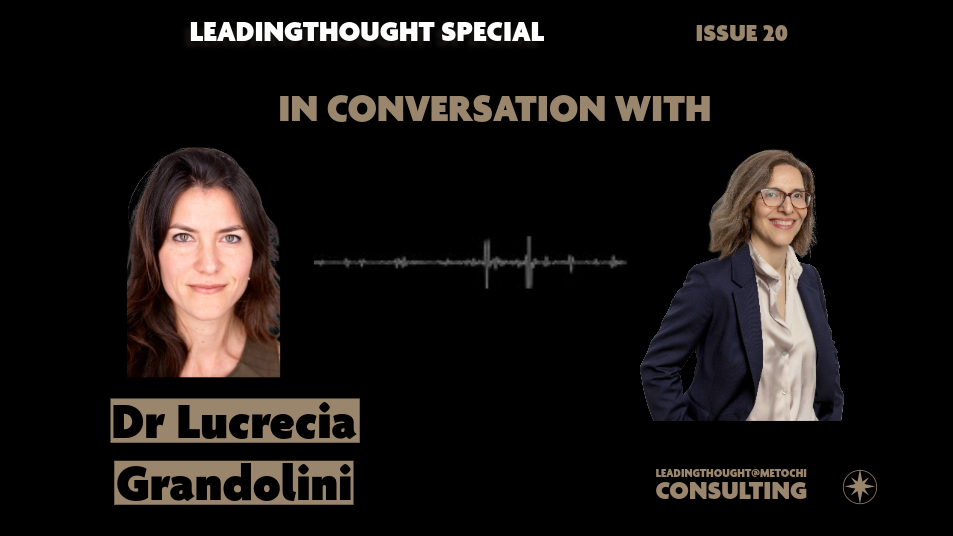
A conversation with
Dr Lucrecia Grandolini
Organisational Psychologist • Leadership Consultant • Former Global Head of L&D, Investec
For the special 20th issue of LEADINGThought, we welcomed Dr Lucrecia Grandolini for an in-depth conversation about what it truly means to lead with human skills at a time when artificial intelligence is reshaping work, workplaces, and the very question of what it means to be human. What followed was one of the richest conversations in the series to date — spanning Lucrecia’s remarkable career journey, the genesis of her new book, the critical difference between connection and communication, and the leadership practices that matter most when uncertainty is the defining condition of organisational life.
THE JOURNEY
HOST
Lucrecia, welcome to my virtual living room and thank you so much for agreeing to join me for this special conversation. I wanted to start by asking if you can help us make sense of your own career so far. I’m very keen to understand what sits at the heart of the work that you do.
DR GRANDOLINI
Great question. By background I’m an organisational psychologist, but I actually started as a clinical therapist working with children in shanty towns in Buenos Aires, Argentina, where I’m from. After a while of working there, even though it was obviously very meaningful, I became preoccupied with the thought that even though I was helping the individual, they were part of a system that was dysfunctional — that was corrupted. What I was observing was that the mothers were getting pregnant so they could receive financial support from the government, and in a way I felt I was colluding with this reality.
So I became more interested in how we can change systems, not just help individuals. I decided to pursue my masters at the London School of Economics in social and organisational psychology, which broadened my lens from the individual to what happens when individuals are in groups, in institutions and organisations.
I then transitioned to management consulting — a very different context. I had the privilege of working in many different countries with many different teams. But after a while I felt I was distant from the psychology. I was working with things related to human capital, but I would say it was more on the capital than on the human, if that makes any sense.
I then took a very interesting role in a financial institution as an organisational psychologist, working with teams, consulting on strategy and culture. I built the learning function there, and later became the global head of learning and development for that bank.
At many points in my career I thought things weren’t connected. But looking behind, I can see a common thread about change, about human psychology, and about leadership as the fastest way to impact and influence change. Those are the golden threads throughout my career.
THE GENESIS OF THE BOOKS
HOST
The two books you’ve contributed to — Leading with Human Skills and Leaders as Architects of Change — feel incredibly relevant at this time. Was there a moment or an insight that convinced you that this was the right time to be focused on these topics?
DR GRANDOLINI
I’ll share a big disclosure here. When we started Leading with Human Skills, it was actually going to be a completely different book. We were going in a different direction. And then all the co-authors — who are distributed around the globe, from Panama to Amsterdam to Spain to the US to London — started noticing this thing about AI. This was about three years ago, so we weren’t sure: is this a big thing, or is it a fad that’s going to go away?
I think we had the intuition that this is actually a paradigm shift — something that is going to challenge and change how we think about work, workplaces, but also question what it means to be human. So we decided to pivot on the spot and change the topic of our book, which I think is a bit of testament about living and leading in times of rapid change and uncertainty.
We did lots of research. We spoke with recruiters, senior leaders, executives. We reviewed the most thought-leading papers from the World Economic Forum, McKinsey, Deloitte, the Institute for Future Studies, together with business schools. From all the research we were able to identify 50 different skills, which we then clustered into 14 chapters. So the book is really about what are the skills we need to develop in order to remain deeply human in the age of AI.
The other book, Leaders as Architects of Change, was an invitation to share my doctoral research findings on how senior leaders navigate uncertainty in knowledge-intensive organisations. The two books are related but address interrelated yet separate topics.
GETTING BETTER AT BEING HUMAN
HOST
I believe there’s a line in the book’s positioning — as machines get better at being machines, humans need to get better at being humans. What underpins that approach?
DR GRANDOLINI
That’s the premise of the book. What we propose is that with AI being able to automate and augment most of the work we’ve been doing, there will be an increasing need to be even more human in the workplace.
I think we still have some unlearning to do from the industrial revolution, where the big metaphor was the organisation as a well-oiled machine. We still use that metaphor today. But AI provides us with this opportunity to really rethink what is work, what is valuable work, and what should remain deeply human.
So we touch on things like trust, practical wisdom, systems thinking, critical thinking and many other skills. Some parts of each skill may be replaced by AI, but there’s a part that is deeply human, and we actually need to double down on those. It’s a very practical book — we provide resources, examples, and practical tips for how you develop these different skills.
CONNECTION VS COMMUNICATION
HOST
What does that mean in practice — what are some of the key insights from the book?
DR GRANDOLINI
Perhaps one of the most interesting is around the importance of human connection. There’s a lot of talk in the coaching and L&D industry about AI being able to coach individuals, about AI chatbots providing personalised learning. But I think there’s a risk we’re confusing or conflating two different concepts: on the one hand, real authentic human connection, and on the other, very efficient, very accurate communication.
There’s a fantastic movie called Her, released around 2013, which follows a lonely writer played by Joaquin Phoenix who develops a romantic relationship with an AI companion called Samantha, voiced by Scarlett Johansson. I remember watching it back in the day and thinking it was a bit futuristic — comfortably parked in the distant future. Today, having watched it again a few months ago, something felt deeply disturbing. It feels much closer to home.
The AI companion industry has grown 700% between 2022 and 2025, because we’re also experiencing this epidemic of loneliness. The World Health Organization said as much. On the one hand we have this technology that guarantees immediate response — it’s always there for you, providing reassurance, instant attention. So there’s something deeply seductive about that.
Yet at the same time, even though we’ve never been as digitally connected as we are today, we’re experiencing loneliness everywhere. In the US, Gallup found that one in five employees reports feeling lonely at work.
The reason is that real human connection is something fundamentally different. When we’re in relation with someone — a co-worker, a partner, a friend — something is at stake. Whether it’s our reputation, our sense of belonging, trust. That’s why relationships feel a bit edgy. There’s also reciprocity — something we give and something we expect to receive.
With AI there’s no reciprocity. Nothing is at stake. It’s a closed loop. And human relationships are deeply imperfect — one day we’re in a mood, the next day something else has happened. Human behaviour is unpredictable, whereas machines are intrinsically predictable. In a real human connection there’s friction, tension, and sometimes conflict. But that’s exactly what makes it authentic — and even stronger. It’s almost as if you don’t really test the strength of a relationship until you have your first big disagreement.
So that imperfection, which is highly inefficient in a way, is what makes the human connection real. That’s one of the central points we argue in the book.
UNLEARNING THE INDUSTRIAL REVOLUTION
HOST
What you’ve painted is a picture of the complexity of human beings. And at the same time, we’ve built modern organisations that reduce that complexity — for efficiency, for control. My own profession talks about resources, human capital. So what is it that we need to unlearn within organisations as we navigate this current phase?
DR GRANDOLINI
Most of our organisational thinking and design is still built around the industrial revolution — building organisations as machines. It’s all about input, controlling the output, measurement, efficiency and productivity at all costs. That worked decades ago when the world was more predictable, when the pace of change was slower, when things were more linear.
However, the limitations of that paradigm are becoming quite evident. We’ve all seen it — you work on a paper for months and it becomes irrelevant the moment you publish it. You create a beautiful project plan and the moment it’s ready, there’s a change in priority, a reshuffle, a reorg. Middle managers are expecting full clarity which never really arrives — this fantasy of a grand reveal of the strategy where suddenly everyone will understand and know where to go. But it never happens.
Even the language reveals this. The word “manager” comes from the Italian maneggiare, which means to drive a horse. At the essence of the word sits control and direction. And we still use it all the time.
I would like to think that with this AI revolution we can evolve some of our own thinking, including the language we use. There’s some unlearning to do, but there’s also new learning — and it will require genuinely new thinking, not just repackaging the old thinking from before.
FOUR PRACTICES FOR NAVIGATING UNCERTAINTY
HOST
In the book you offer a framework — four aspects that can help us think about humans differently and perhaps unlearn some of the ways we’ve managed people. Can you talk us through them?
DR GRANDOLINI
When I speak about leading through uncertainty — and this comes from my doctoral research — the leaders who were really good at not just navigating and surviving uncertainty, but actually using it as a strategic asset for growth, innovation, and learning, displayed four practices.
The first has to do with being comfortable with not knowing. From our schooling system onwards, we’re rewarded for having the right answer — not the right question. We then go into university, become managers, and we’re constantly being rewarded for certainty. However, in a world of uncertainty and unpredictability, the question is more important than the answer. So sitting in this space of discomfort when we don’t know — not as a weakness, but as a strategy to invite curiosity, exploration, and inquiry.
The second is trust. In highly volatile environments, people aren’t just looking for answers. They’re looking for a safe space. They’re thinking: can I trust the person leading us? Trust becomes a buffer for uncertainty, and it’s obviously linked with psychological safety — one of the key cornerstones for adaptability, learning, exploration, and innovation.
The third is generative dialogue. We go to meetings and we already have the answer. We’re actually just exchanging arguments — not thinking together. A beautiful definition of dialogue by Scharmer is this ability to think together. Leaders who are great at this invite dissent, invite alternative viewpoints, make sure everyone can voice their opinions. When we face complex problems, no one has the answer. Each of us holds a little piece of the puzzle. Dialogue is how we bring all the pieces together.
And the last is presence. Not just being physically present, but being emotionally available. Being able to remain grounded when everything around us is shifting. This has to do with having a high capacity for self-regulation, and being able to stay with the here and now — not what we think is going to happen, not what happened yesterday, but really facing what is happening in front of us. Being able to name what is true, and what is not yet true but we may know later.
MICRO-MOMENTS AND SELF-AWARENESS
HOST
Can you put your practitioner’s hat on now and give us a sense of what this looks like in practice — both for developing leadership skills and as a leader yourself?
DR GRANDOLINI
In practical terms, it’s perhaps not a big change. It’s about micro-moments. Rather than jumping into an answer, you create some silence, or you invite the perspective of someone else. Rather than going from meeting to meeting with the heat of things, you become more aware of how you carry yourself — how you show up from one context to the next.
I’ve been a leader of teams myself, and unfortunately, like many leaders, I’ve had to restructure, move roles from one country to another, say goodbye to very dear colleagues. It’s extremely difficult. And at those difficult moments, it’s not the perfect plan that brings people together. It’s not the perfect execution. It’s actually the trust of those longstanding relationships — built over all the months, even years or decades, of working with those people.
Trust compounds through these micro-moments of engaging, being authentic, leaning into the difficult conversation rather than being vague when it would be much easier.
There’s also the work on ourselves. In my research on uncertainty, I speak a lot about how the way we manage the external uncertainty will partially be a function of how we manage our own internal uncertainty. How aware are we of how we respond? Do we go into anxiety? Do we become the firefighter trying to fix everything? Do we become the rescuer, playing the role of therapist with our colleagues? It’s not about labelling, but about creating awareness — because awareness creates choice and we can do something about that.
DESIGNING FOR UNCERTAINTY
HOST
I wanted to ask about your reflections on human development at this time — what are those elements we need to be most aware of in organisations at this time?
DR GRANDOLINI
If you look around, most organisations still follow the schooling system when it comes to development. You have programmes tailored to your level. When I was in a Big Four consulting firm, your career path was exactly connected to your learning path — if you wanted to go from senior consultant to manager, these were the courses you had to take, the experiences you needed. You didn’t have to do any thinking on your own. You just needed to obey, comply, and be disciplined, and the promotion would come.
That linearity no longer matches reality. I don’t think it’s about offering new programmes or more programmes. The problem is the whole concept of programme. It’s about rethinking work and rethinking organisations so we design uncertainty into them — not despite it.
There’s a very interesting study of two financial institutions. One reduced uncertainty in every possible way, including how they developed people — structured onboarding, set programmes at every level, all the answers laid out for you. People were extremely competent with deep expertise. However, in the long run they didn’t outperform the other organisation.
The second institution — one of the most successful banks in the world — maximised uncertainty. When you joined, there was no onboarding programme. The advice was: go and talk to as many people as you can, network, find your own answers. People were very stressed, and it felt overwhelming and chaotic. But if they were able to thrive after a few months, they had much more connectivity, much more access to the entire knowledge of the organisation, because they had been networking and connecting with so many colleagues. And because there was no set programme, they were much more malleable and adaptable to what they wanted to do, their own passions, and what the organisation needed.
In the long run, this organisation outperformed the other bank. What I’m trying to say is that it’s not about a training programme. It’s about the culture we create — the conditions we design in organisations every single day. We are choosing either to reduce uncertainty and provide all the answers, or to build the muscle of having to be resourceful, having to lead through ambiguity, having to connect with different colleagues to come up with a better answer.
Those organisations are the ones that will stand out in the future — because they already have the conditions inside themselves that replicate the external environment, rather than trying to protect against it.
CLOSING
HOST
I think that’s a perfect full-circle moment on which to end. For me, one of the most important things is the recognition that human complexity can be a strength, and that’s something we could design for in organisations. Lucrecia, it has been amazing to have this conversation. I think I could go on for much longer, and I had a series of questions I didn’t get through! But a very rich conversation — perhaps we do a sequel at some point. It was lovely to talk to you.
DR GRANDOLINI
Thank you so much. Thank you.
© 2026 Metochi Consulting. All rights reserved. LEADINGThought is a publication of Metochi Consulting.